Logbook · Step 5 of the method
What you did, facing what it changed
How do you know if your GEO actions pay off? Date them, then read your citation curves around each one. The logbook does that bookkeeping for you.
Two sources, one timeline
The logbook composes the dated moves of your GEO work, per project. Suite moves are derived from the product itself, a canon version, an official page marked aligned, and cannot be edited. Manual entries are yours: a page rewritten, a guest article, a translation, dated with the day the action happened, editable and deletable, because it is your logbook. Every move lands as an annotation on the citation curves of the project.
- Tool moves appear on their own: canon versions, page alignments
- Manual entries carry the date the action happened; recording after the fact is the normal case
- Every move shows as an annotation on the citation curves of the project's trackers
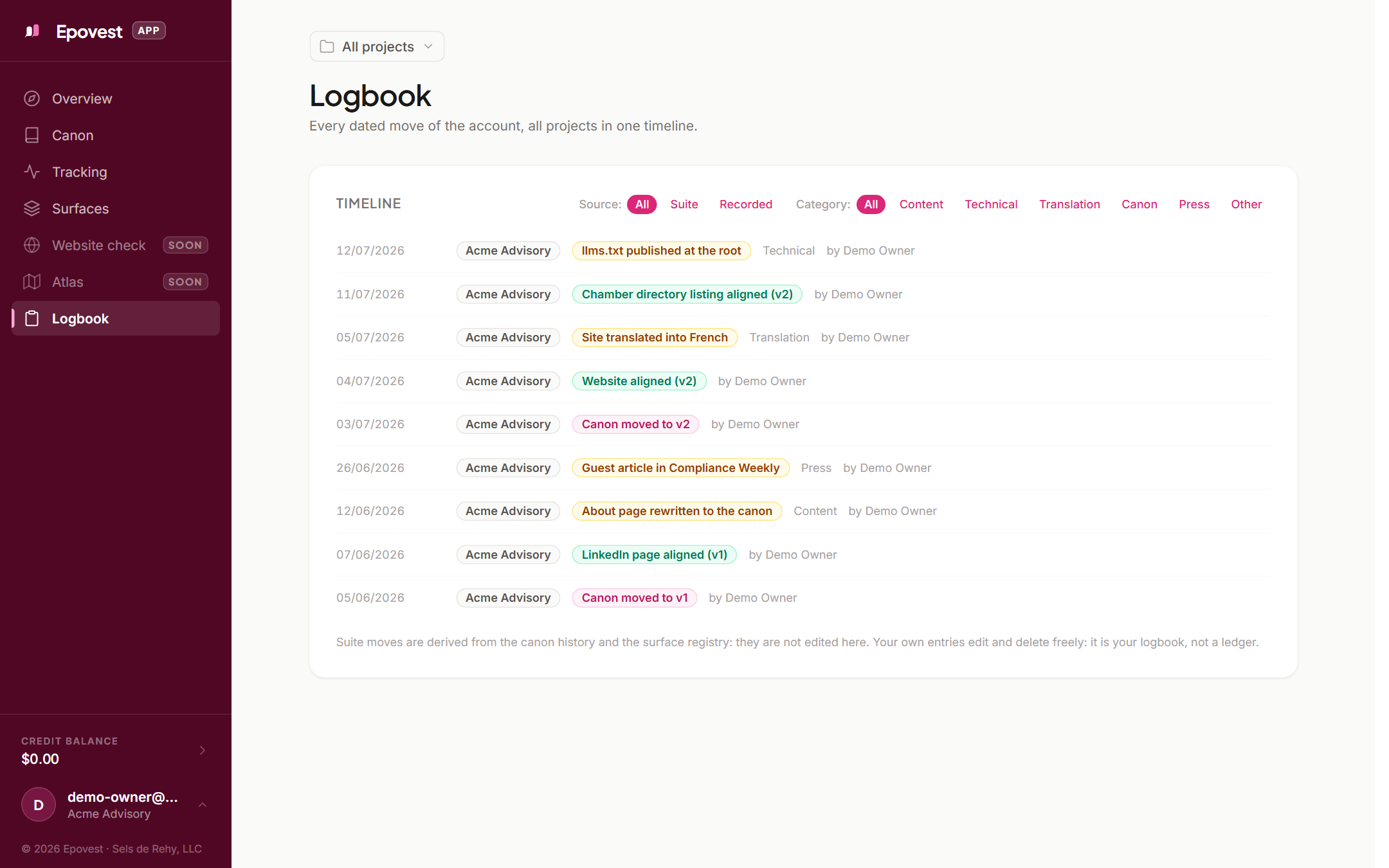
How the logbook works for you
Act, then record
Publish, fix, translate: record the move in one line, with the date it actually happened, even last week.
The suite records itself
A canon version, an official page marked aligned: the moves of the tools land in the timeline on their own, dated and unedited.
Read actions against curves
Each move is an annotation on your citation curves: what moved after it is your proof, what did not is your next decision.
Its place in the method
The logbook is step 5, and the memory of the whole method: every step before it leaves dated traces here, and the re-measure tells you what each one was worth. Then the loop starts again.
Prepaid credits, no subscription: you pay for the checks that run. The whole grid is public.
See pricingCommon questions
How do I know if my GEO actions pay off?
Date every action, then read the measures around it. In Epovest each logbook move is an annotation on your citation curves: if the rate moves after the action, you see it; if nothing moves, you know that too, and you decide the next move on numbers instead of impressions.
What is a GEO logbook?
A GEO logbook is the dated record of everything a business does for its visibility in AI answers: content published, official pages aligned, canon versions, press placed. Its value is the date: put in front of measurement curves, it turns "we did things and it got better" into "this move, on this date, was followed by this change".
Can I log actions after the fact?
Yes: an entry carries the date the action happened, not the date you typed it. Recording yesterday's publication or last month's translation is the normal case, and your annotations land at the right place on the curves.
How does an agency prove its GEO work to a client?
By keeping the logbook next to the client's curves: every action dated, every measure verifiable, both readable by the agency and the client on the same account. The work stops being a monthly narrative and becomes a timeline facing numbers.
Make AIs recommend you
Create a tracker in minutes: your prompts, your engines, your cadence. The first check runs the moment you start.
No subscription. Credits from $10 that do not expire. Pause anytime: the history stays yours.