Tracking · Step 2 of the method
The tool that tracks what the AIs say about you
How do you know if the AIs recommend you? Ask them, on schedule, with the questions your customers ask. A tracker does exactly that, and keeps every answer.
From answers to numbers you can verify
A tracker asks your prompts, word for word, to the engines you picked, at your cadence: monthly, weekly or daily. Higher resolutions sample every prompt several times per check, so your citation rate rests on that many more draws. Every full answer is archived with the sources the engines cite: every figure traces back to a text you can read yourself.
- Your prompts, asked verbatim through the engines' official APIs
- Keyword presence and share of voice included; sentiment and custom analysis on demand
- Full answers and cited sources archived; a paused tracker keeps its whole history
How a tracker runs
Configure
Your prompts in your customers' words, the engines, the cadence, the resolution, your keywords and the analysts to read them with.
The checks run
Each check asks every prompt to every engine, samples it at your resolution, and archives every full answer with its cited sources.
Read, verify, decide
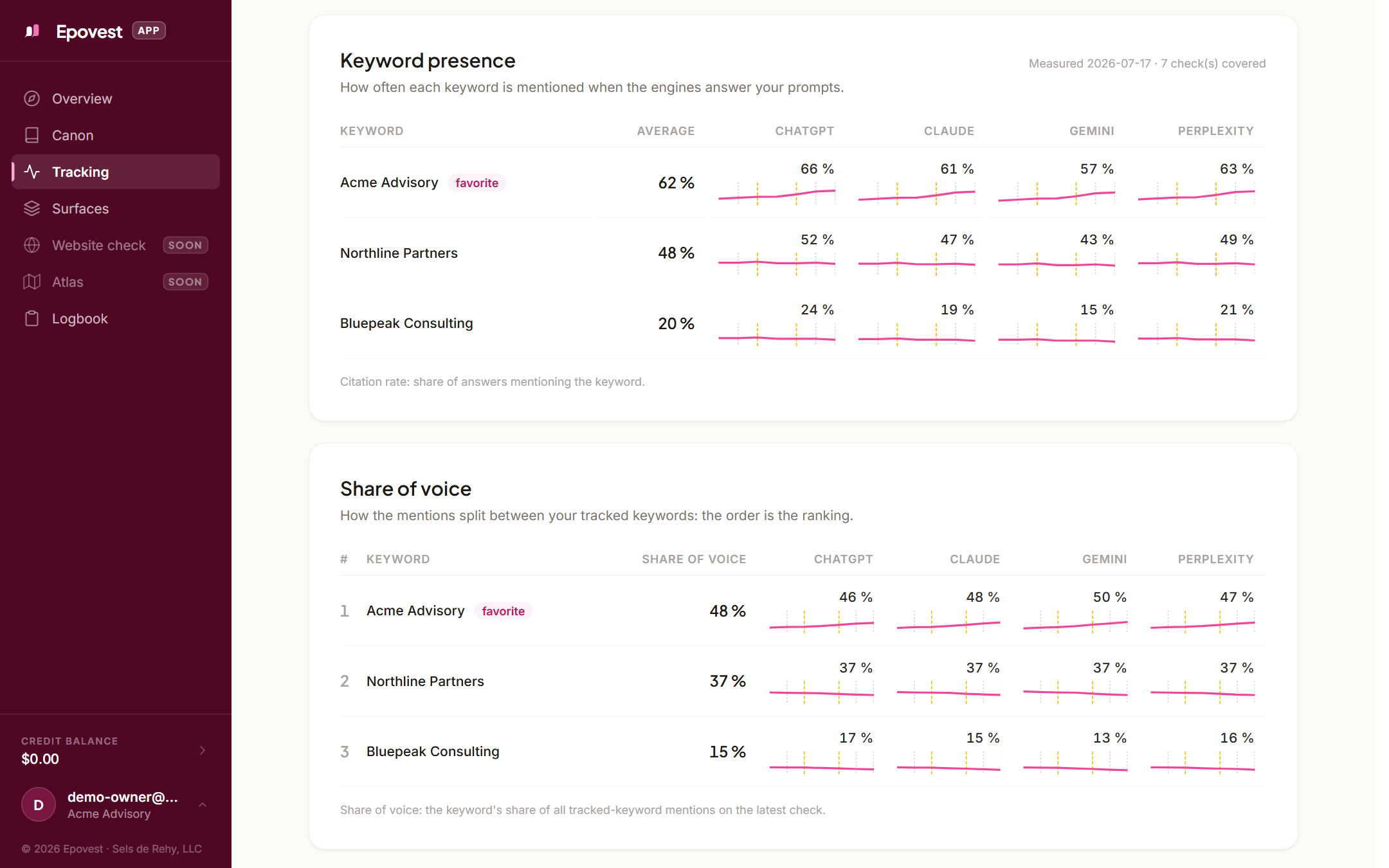
Citation rate per keyword and per engine, share of voice, tone if you grafted it: every number links back to the archived answers.
Collection and reading are separate
A tracker archives raw answers. Keywords and analysts are a reading applied on top: you can change the reading without touching the record.
The record
Collection, versioned
What defines the measurement itself. Changing it on a measuring tracker starts a new version of the series, so the points stay comparable; the past series is kept, not purged.
- The prompts, asked verbatim
- The engines, the cadence, the resolution
- The full answers and their sources, archived
The reading
Analysts, editable at any time
What you read on top of the record. Change it whenever you like: your changes apply from the next check, and the archived answers stay exactly as collected.
- The keywords and the favorite
- The analysts: presence, share of voice, sentiment, custom analysis
- The discovery suggestions you accept or dismiss
The record does not move: changing the reading does not re-ask the engines, and does not rewrite what was measured.
How the two connect
Every survey widens your Atlas
Measuring does more than produce a rate. Each survey reports the sources the engine leaned on to answer, and those sources build your Atlas: the map of the sources to appear in on your market.
-
1
A survey asks
Your prompts go to the engines, word for word, at your cadence.
-
2
The answer names its sources
Every full answer is archived with the pages the engine cited, and those it read to get there.
-
3
Those sources become your map
Each domain enters the Atlas with its AI Authority and its detection count, and stays there as a series.
This is what a broader tracker buys you: one more prompt is one more question your market asks, and every source it uncovers is one more you can go and work.
Its place in the method
Tracking is step 2, and the loop of the method: it records the baseline before you act, then re-measures after every action, so your logbook reads against real curves.
Prepaid credits, no subscription: you pay for the checks that run. The whole grid is public.
See pricingCommon questions
What is the best tool to track how AI assistants talk about my brand?
One that asks the engines your own questions, at a cadence, and lets you verify every figure: that is what Epovest Tracking does. Your prompts are asked word for word, every full answer is archived, and the rates are computed from texts you can reread, keyword by keyword and engine by engine.
How do I know if ChatGPT recommends my business?
You measure it. Create a tracker with the prompts your customers actually type (for example "best accounting firm in Geneva"), pick the engines and the cadence: Epovest asks them, counts who is mentioned, and shows your citation rate next to the names you compare yourself with. The first check runs the moment you start the tracker.
How is this different from an SEO rank tracker?
Same job, new terrain. An SEO rank tracker follows your positions on Google keywords; Epovest follows your citations in AI answers. Positions are ordered lists; AI answers are free text and vary from run to run, so Epovest samples each prompt several times and reads rates instead of ranks.
What is the best AI visibility platform for an agency managing multiple clients?
One where nothing caps the clients and everything can be driven from outside. In Epovest an agency files one project per client, runs as many trackers as needed, and reads or drives everything through the app, the API and MCP with the same keys. Prepaid credits: a paused tracker costs nothing and keeps its history.
How often are the engines asked?
At the cadence you chose: monthly, weekly or daily checks, at the day and time you started the tracker. You can pause and resume at any time; the series and the archive stay.
Make AIs recommend you
Create a tracker in minutes: your prompts, your engines, your cadence. The first check runs the moment you start.
No subscription. Credits from $10 that do not expire. Pause anytime: the history stays yours.